Time to fully integrate brand comms
By Rachel O'Connor, Founder, Force4Good
A recent article from The State of Brand caught my eye. It discusses how PR is celebrating the fact that 85.5% of AI citations come from earned media, before exploring the role of owned media and other communications channels in shaping what AI platforms ultimately serve up to users. It's worth a read and certainly worth thinking about as we all work out how best to leverage earned, owned, shared and paid channels in this evolving landscape. [thestateofbrand.com], [brandcited.ai]
What struck me most was that it challenged one of the most widely shared viewpoints in communications right now, one I've championed myself: that AI has somehow handed victory to PR because the majority of citations come from earned media.
Look deeper
As someone who has spent almost three decades championing the value of good, joined-up communications, I should probably welcome that argument. If AI platforms favour editorial content and independent sources, surely that's good news for PR professionals. But when you look beyond the headlines, a more interesting story emerges.
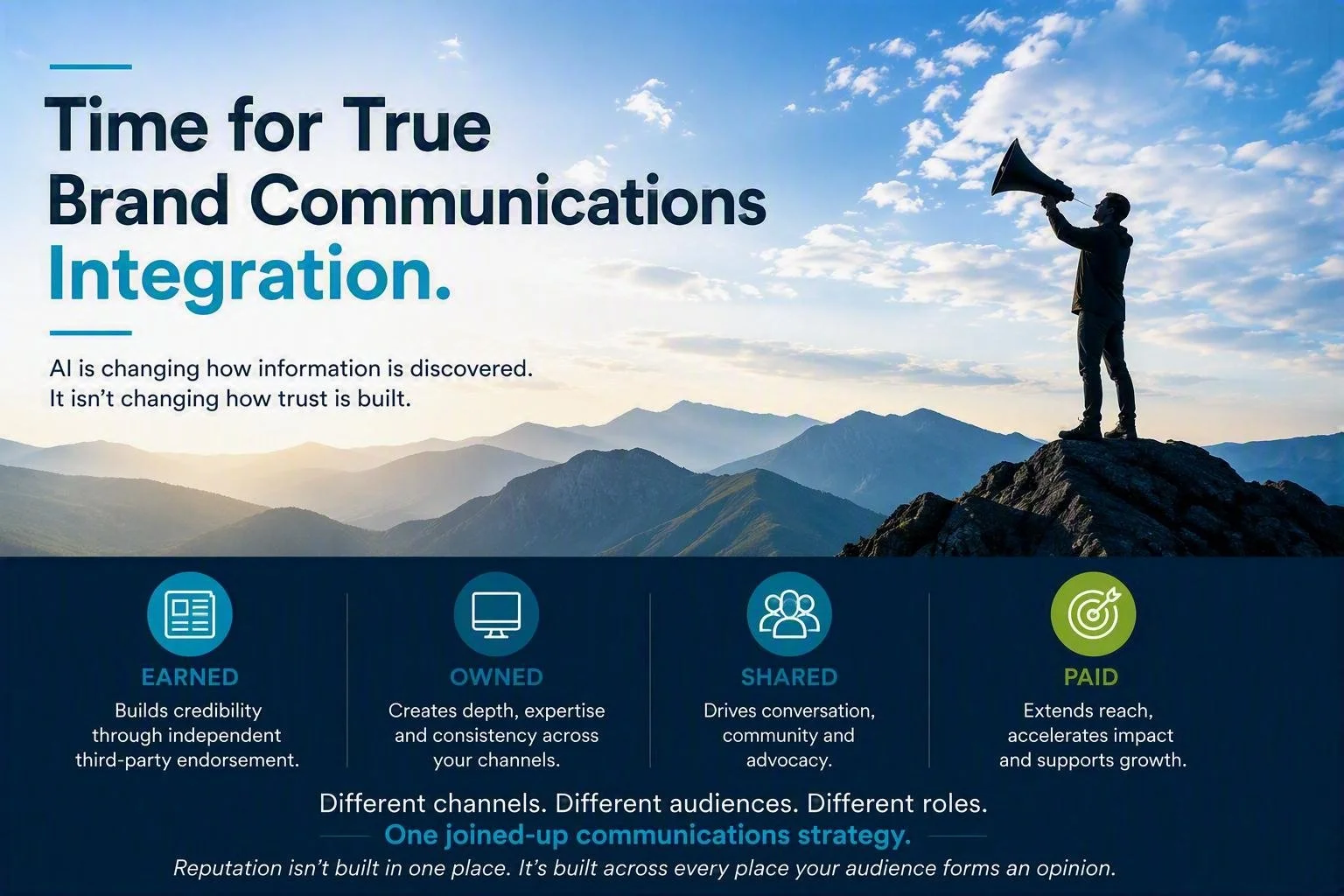
The conversation shouldn't be about whether earned media has won. It should be about how communications leaders bring earned, owned, shared and paid activity together as part of a joined-up brand communications strategy. Because that's where trust, reputation and influence are really built.
It's why I've spent much of my career championing integrated communications rather than treating PR as a separate discipline. Often to the frustration of teams and clients - stay in your lane Rach.
The brands and businesses that succeed are rarely those shouting loudest in one place. They're the ones creating a consistent story across multiple touchpoints, audiences and channels. To achieve that, it's just as important to agree a clear brand communications strategy, purpose, values and behaviours that the whole organisation understands and lives by.
Earned media on its own won't build reputation, trust or long-term influence. Equally, leaving it out of your communications mix is a missed opportunity. Its real value comes when it's connected to a wider brand communications strategy and reinforced through other channels and touchpoints.
The danger of a false choice
One reason the current AI debate has generated so much attention is that it appears to validate what many PR professionals have been arguing for years.
For too long, earned media has been treated as secondary to paid channels or judged against marketing metrics that don't always capture its value.
So, seeing headlines that position earned media as the champion of AI visibility is understandably appealing.
The reality is more nuanced.
For years, organisations have treated communications disciplines separately:
Earned media built awareness and credibility
Owned media supported marketing and conversion
Shared media created engagement and community
Paid media delivered reach and leads
The State of Brand article highlights that AI systems appear to draw information from a much broader ecosystem than traditional media alone. Reddit, Wikipedia, specialist publications, expert commentary and owned content all contribute to what AI platforms surface and cite. [thestateofbrand.com], [brandcited.ai]
It's also worth noting that each AI platform is developing its own approach to assessing authority, credibility and relevance. One size is unlikely to fit all, and that's something communications leaders should be monitoring closely.
For me, though, the bigger lesson isn't about AI. It's about brand communications.
Authority and reputation have never been built through a single article, campaign or channel. They're built through a series of touchpoints and signals that reinforce one another over time. That's the value of strong planning, audience insight, channel selection and integrated campaign development.
Earned media still matters. Massively.
Independent endorsement remains one of the most powerful tools available to communicators. A feature in a respected trade publication, a national media interview, an analyst report or commentary from a credible third party builds trust in a way that self-published content simply can't.
People still place greater weight on what others say about you than what you say about yourself. That hasn't changed.
If anything, AI may increase the value of trusted editorial sources because they provide validation and context beyond a brand's own channels. [thestateofbrand.com],
The challenge is that earned media alone is not enough. The much-shared statistic that 85.5% of AI citations come from earned media is, in some ways, brilliant PR for PR. But it risks distracting us from the bigger issue.
Too many organisations still run media relations, content, social, stakeholder engagement and internal communications as separate workstreams. They may share the same objectives, but they're often planned, executed and measured independently. In a world where reputation is increasingly built across multiple channels and AI systems pull information from multiple sources, that disconnect becomes a weakness.
Joined-up planning has never been more important.
Where earned media creates credibility, owned media creates depth.
Your website, insight hub, blog, executive LinkedIn presence, newsletter, reports and knowledge centres allow you to demonstrate expertise consistently, at scale and directly with the audiences that matter most.
Unlike earned media, you control the timing, frequency and detail. You decide which topics to own, champion and explore.
Research referenced in the article suggests that AI platforms increasingly reward expertise, consistency and topic authority over time, rather than simply reacting to occasional spikes in attention. That's where owned content becomes particularly valuable.
Not because organisations need to publish more content, but because they need to publish better content. Content that is useful, relevant, insightful and aligned to the topics they genuinely want to be known for.
The influence ecosystem is bigger than most communications plans
Perhaps the biggest lesson from this debate is that influence now sits in more places than many communications strategies recognise.
Media coverage remains important, but it's just one part of a much broader influence ecosystem that can include many of the channels that arent always owned by PR or brand strategy.
Trade and specialist publications
Industry newsletters
LinkedIn
Substack authors
Podcasts
Industry communities
Review platforms
Expert forums
Customer feedback channels
Analyst commentary
Emerging creator and knowledge networks
People increasingly discover information through multiple routes. AI platforms are simply reflecting that reality by drawing from a much wider range of sources. [thestateofbrand.com], [machinerelations.ai], [brandcited.ai]
For communications leaders, this means taking a broader view of influence.
Building a balanced brand communications strategy
In my view, the organisations best positioned for the future will be those that build connected communications programmes rather than isolated activities.
Every significant campaign should combine earned, owned, shared and paid activity around the same strategic narrative.
A launch shouldn't stop at media coverage.
It should also generate:
Internal comms
LinkedIn
Website content
Thought leadershipStakeholder engagement
Customer comms
Each channel plays a different role, reaches different audiences and supports different business objectives. The magic happens when they all reinforce the same strategic narrative.
Working this way improves both efficiency and effectiveness. It helps organisations align around key business priorities, ownable topics and meaningful moments rather than creating disconnected streams of activity.
That's how reputations are built. Through consistency, relevance an by channels working together rather than competing for attention.
What should communications leaders do now?
Stop thinking in terms of earned versus owned
Start thinking in terms of influence ecosystems
Understand where stakeholders get information, not just where journalists publish it
Ensure every campaign leaves a lasting footprint through content, insight and expertise
Focus on quality, consistency and relevance rather than simply chasing volume
The strongest reputations are rarely built through one big moment They're built through the repeated demonstration of expertise, credibility and value over time.
My take
The more I read about AI visibility, the more it reinforces something many of us in communications have believed for years.
It's built through a clear brand strategy, a strong sense of purpose, consistent communications and a balanced mix of trusted endorsement, useful content and expert voices.
The channels may evolve. The principles remain the same.
The organisations that succeed won't be the ones chasing every new algorithm or acronym. They'll be the ones that understand how trust is created, maintained and reinforced across media, content, communities and conversations.
That's not a victory for earned media. Nor is it a victory for owned media. It's a reminder that the brands and organisations that build lasting trust are rarely reliant on a single channel. They combine earned, owned, shared and paid activity around a clear purpose, a clear story and a consistent set of values.
The AI era doesn't change that. It simply shines a brighter light on it.
Sources and Further Reading
This article was inspired by PR Didn't Win the AI Era. Reddit and Owned Media Did published by The State of Brand and informed by wider industry research from Muck Rack, Meltwater, Similarweb and Machine Relations exploring AI citations, authority signals and the evolving relationship between earned, owned and community-driven influence. [thestateofbrand.com], [thestateofbrand.com], [machinerelations.ai], [machinerelations.ai]
Rachel O'Connor is Founder of Force4Good, a strategic communications consultancy helping organisations build reputation, trust and influence through integrated communications, PR and brand strategy.