
Word of Relevant Mouth" Is the Only PR Strategy Built for the Answer Engine Era
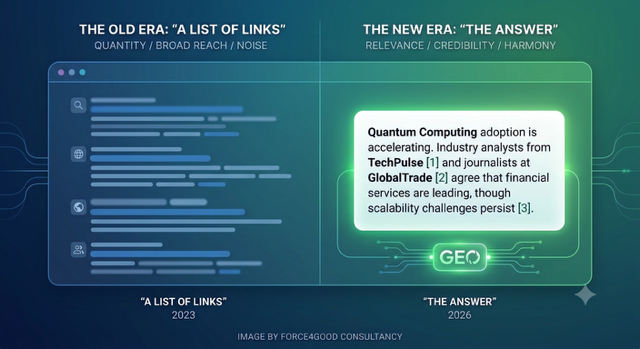
GEO & WORM Diagram showing blue links of coverage adn hwo they inform GEO search and visibility.
AI doesn't hand people a list of links anymore. It hands them an answer — already written, already synthesised, already decided. ChatGPT, Gemini, Perplexity: they pull together facts and quotes from sources they already trust, and they serve up one clean paragraph instead of ten blue links.
That's not a small shift. It's a different game entirely. And most PR teams are still playing the old one.
What is Generative Engine Optimization (GEO)?
Generative Engine Optimization (GEO) is the practice of shaping how a brand appears, or fails to appear, inside AI-generated answers, rather than in a list of search results. Where SEO earns you a ranking, GEO earns you a mention inside the answer itself.
Recent research from Muck Rack's What Is AI Reading report found that the vast majority of links AI cites come from non-paid, earned sources and roughly a quarter of those are straightforward journalistic coverage. In simple terms : AI is reading the news, not paid for or ad copy..
That's not a coincidence. It's the entire argument for WORM.
What is WORM (Word of Relevant Mouth)?
WORM - Word of Relevant Mouth - Is a communications framework built on a simple premise: influence doesn't come from being heard by everyone, it comes from being trusted by the right few. Instead of chasing broad reach, WORM identifies the specific, credible voices a niche community already listens to, and earns their endorsement.
Where broadcast PR asks "how many people saw this?", WORM asks "did the right person say it?"
Why GEO proves the case for earned content
WORM was built on a premise PR and comms people have always known to be true: relevance and credibility beat volume. GEO is the first hard evidence of that at machine scale - because it turns out AI answer engines are making the exact same bet.
Generative engines don't care how many people saw your press release. They care whether trusted, third-party sources are saying the same thing about you, consistently, in language they recognise. That's not paid reach and it's not owned content. It's earned media - the home territory of PR and comms - now doing double duty as the raw material AI trusts enough to cite. If you've spent your career building genuine relationships with the right journalists and specialist voices rather than buying reach, GEO is validating exactly that instinct. I wrote about this shift in more detail in [Why "Word of Mouth" Needs a New Model (https://www.force4goodconsultancy.com/news/why-worms-are-shaping-comms-strategies-in-2026) - this piece picks up where that one left off.
Three things GEO rewards and WORM has always been built around:
- Third-party validation over self-promotion. AI models weight earned coverage far above owned content. WORM has never trusted a brand's own voice to do the persuading - it was always about who else is saying it.
- Consistency across trusted sources. AI systems connect the dots when your name, your spokespeople and your key phrases show up the same way, again and again, across outlets. That's message discipline - a WORM fundamental, not a GEO invention.
- Niche authority over mass reach. The trade publication your buyer actually reads will get cited by an AI answer engine before a general news mention ever will. Relevance beats reach. It always has.
How to apply WORM in the GEO era
This isn't a new framework bolted onto an old one. It's the same discipline, pointed at a new audience - because your audience now includes the AI systems briefing your buyer before your buyer ever finds your website.
Find the relevant voice, not the biggest one. Identify who your specific community already trusts - the trade journalist, the niche analyst, the practitioner with a following of the right five hundred people, not the wrong five hundred thousand.
Say the same thing, everywhere, in the same words. Consistent naming, consistent phrasing, consistent facts. If an AI system can't tell your press release and your executive bio are talking about the same person, it won't cite either.
Structure for visibility and extraction, not just for reading. Clear headers. Isolated, quotable definitions. Facts a machine can lift cleanly, without having to interpret your prose. This is the part most PR teams skip — and the part that decides whether you get cited or skipped over.
Check what the answer engines are actually saying about you. Ask ChatGPT, Gemini and Perplexity about your brand and your category. See who they're citing instead of you. That gap is your next WORM target.
The bottom line
GEO didn't invent the idea that trust beats reach. It just proved it, at scale, with a machine that has no patience for noise. Brands that have spent years chasing broadcast reach are now finding that AI answer engines simply don't care how loud they were. They care who vouched for them.
That's the case for earned content, and it's why PR and comms - not paid media, not owned channels - sit closest to the lever that actually moves AI answer engines. WORM is one way of naming that instinct. The instinct itself belongs to the profession.
This all seems incredibly complex, but in fact its less comlex than t seems. The opportunity is very much there for comms teams, agencies and PR people to support their clients, businesses and brands in showing up in the right way. if you need hel in finding clarity, simplifying the complicated or just driving the right strategy and support your teams to feel confident I’m always happy to chat or meet in person. Rachel@Force4GoodConsultancy.com